

The Freud–Jung Split: When Psychoanalysis Fractured
The story of their first meeting, their dramatic break, and a classic 1925 article reflecting on the rift between them.

I’m not saying I’m obsessed with psychology, but a few years ago I did spend an entire year documenting a significant person, event, or landmark in the history of psychology.
The project eventually became my book On This Day in Psychology, and along the way I discovered countless fascinating moments in the discipline’s history.
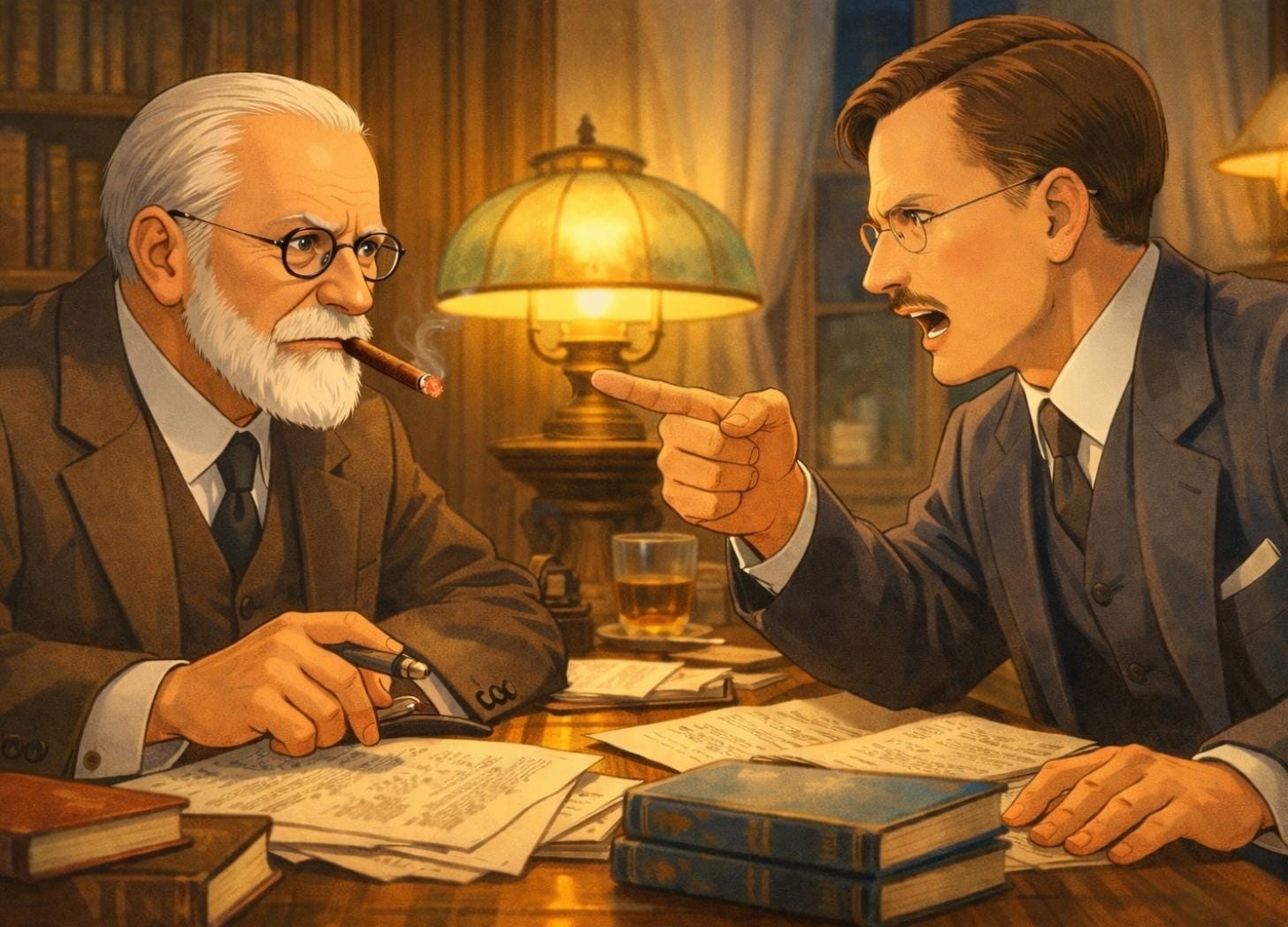
One of my favorites occurred on 3rd March 1907, when Sigmund Freud and Carl Jung met for the first time. The meeting took place in Freud’s apartment at Berggasse 19 in Vienna, and according to the story, the two men talked for 13 hours without interruption.
I’ll admit I was initially skeptical about the 13-hours claim, until I heard Jung confirm it himself in the following video clip.
I just paid a visit to him in Vienna then we talked for 13 hours without interruption. We didn’t realize that we were almost dead at the end of it, but it was tremendously interesting. He was the old man and had great experience and he was of course way ahead of me, and so I settled down to learn something.
Every 3rd March, when I post about this famous day in psychology across my social media channels, I always receive a number of irreverent comments suggesting that talking for 13 hours without interruption surely means that cocaine must have been involved!
But I digress.
At the time of their first meeting, Freud was already the founder of psychoanalysis, while Jung was a rising star in psychiatry at the Burghölzli clinic in Zurich. Their marathon conversation marked the beginning of what would quickly become one of the most important intellectual partnerships of the 20th century.
Freud was immediately impressed by Jung. In the years that followed, the two men exchanged hundreds of letters and collaborated closely in promoting the new psychoanalytic movement. The surviving correspondence between them, later published as The Freud/Jung Letters, reveals the intensity of their relationship and the high hopes Freud placed in his younger colleague.
For a time, Freud saw Jung not simply as an ally but as the man who would carry psychoanalysis forward.
Freud’s Early Hopes for Jung
Freud’s confidence in Jung can be seen clearly in his letters. In one written in 1909, Freud used a biblical metaphor, describing himself as a Moses figure who could only glimpse the promised land of psychiatry, while Jung would be the Joshua who would lead others into it.
Freud also referred to Jung as his “crown prince” and successor, someone he believed could lead psychoanalysis into the future.
There were practical reasons for this enthusiasm. Jung was nearly twenty years younger than Freud, an energetic researcher, and already well respected in academic psychiatry. Freud also believed Jung’s background might help psychoanalysis gain broader acceptance. As a Swiss Protestant rather than a Jewish Viennese intellectual, Jung represented a figure who could introduce Freud’s ideas to a wider European audience.
For Jung, the relationship initially had the tone of mentorship. In his own letters he expressed what he called his “unconditional veneration” for Freud as both a man and a researcher.
For several years, their alliance shaped the course of psychoanalysis.
But the very intensity of that early alliance also set the stage for one of the most famous schisms in the history of psychology.
The Growing Rift
Despite Freud’s early confidence in Jung, tensions between the two men gradually began to surface.
At first, the differences were subtle. Jung admired Freud’s work and had initially embraced many of the central ideas of psychoanalysis. But over time, he began to question some of Freud’s most fundamental assumptions, particularly Freud’s view that the driving force behind much of human behavior was sexual in nature.
Freud saw the concept of libido primarily as sexual energy. Jung, however, increasingly viewed libido more broadly as a form of psychic energy that could express itself in many different ways, including creativity, spirituality, and symbolic life.
These theoretical differences were not merely academic. They touched the very foundations of psychoanalytic theory.
By the early 1910s, the collaboration that had begun with such enthusiasm in Vienna was becoming increasingly strained.
By 1913, the relationship had reached breaking point. In January of that year, Freud wrote to Jung proposing that they “abandon our personal relations entirely” and continue only with strictly professional contact. Jung accepted the proposal, bringing their once-intense collaboration to an abrupt end. What had begun with a thirteen-hour conversation in Vienna now concluded with a brief and formal exchange of letters.
James Oppenheim on the Break Between Freud and Jung
Among those who reflected on the Freud–Jung split was James Oppenheim, an American poet, novelist, and editor who also had a keen interest in psychology. Oppenheim was an early follower of Jung and was also a lay analyst.
Note: A lay analyst is a psychoanalyst who practices therapy without holding a medical degree. Freud defended the practice of lay analysis, arguing that effective psychoanalytic work depended not on medical credentials but on rigorous training in psychoanalytic theory and, crucially, the analyst’s own personal analysis. Some prominent early figures in psychoanalysis, including Otto Rank and Theodor Reik, were also lay analysts.
In 1925, Oppenheim published an article titled “The Break Between Freud and Jung.” Written less than two decades after their split, it offers an early reflection on how their rupture was understood at the time. As with any contemporary account, the interpretation inevitably reflects the author’s own perspective, which in this case appears to be more sympathetic to Jung.
The article is reproduced below in full.
At the time that Dr. Freud was making his discoveries in Vienna, Dr. Carl Jung, a young psychiatrist, was conducting certain experiments in Zurich, Switzerland. These were of a dry technical nature which need not be given here, but they led to a tentative theory of an unconscious mind. It was while he was engaged on these experiments that Jung first read the work of Freud. He knew at once that he had found his master and hastened to become Freud’s pupil and colleague. He did more than that. At that period Freud was the laughing stock of Vienna, and wherever his work penetrated. He was jeered and ridiculed for his fantastic notions, and was suffering the bitter fate of all pioneers. Jung was in a powerful position at Zurich, and at once proceeded to enlarge and deepen the fight for Freud. He became the most powerful exponent of the Freudian psychology, and helped to bring the new knowledge and new technic into its first acceptance by the world.
Freud looked upon Jung as upon a favorite son. They fought shoulder-to-shoulder, the work spread, and they were invited to this country to give lectures. In Switzerland, Austria, England and America the psychoanalyst made his appearance, and the world of the intelligentsia awoke with a shock to the sexual theory. Among the cultured everywhere there was discussion of the Oedipus complex, the repressions, the sexual perversions, the idea that much that we had thought purely spiritual, like art and religion, were merely masks for sexual complexes. The psychoanalytic movement, held firmly together by two great men, was forging ahead.
However, Jung, from his continued analysis of patients, and from his own experiences, was beginning to form doubts in his own mind. There was something, he began to think, inadequate in Freud’s theory. He hardly dared, at this time, to make any formal criticism; but finally, after a great conflict, he was moved, even inspired, to write his first great book. This book is entitled “The Psychology of the Unconscious.”
He has said of it that it was a voyage of discovery. He himself, when he started it, hardly knew to what depths it would lead him, to what conclusions it would force him. But when he was finished, he knew that he could no longer withhold his own point of view and that this would inevitably lead to a break with Freud.
It proved to be so. Freud was shocked and appalled. He sent the manuscript back with a letter in which their relationship was ended. He said that Jung had betrayed the psychoanalytic movement, that he had ventured out beyond the bounds of science, and that he was seeking to destroy the greatest values in the new psychology.
Of course such a break was inevitable, and in the end it proved fortunate. It set Jung free. He could now go on, without hindrance, in his great task, which led finally to the greatest contributions thus far made.
The break itself may be traced to a divergence between two theories of the unconscious. As will be remembered, Freud’s theory would define the unconscious as something which is produced after we are born, and when the repressions begin. All that is anti-social, that flies in the face of conventional morality and the law of the land, everything that is taboo, gets walled off from the conscious mind, and is henceforth the unconscious mind. The unconscious then is a storehouse of the evil, the thwarted, the unconventional, the instinctive.
Jung does not deny that a part of the unconscious is exactly of this nature. But in “The Psychology of the Unconscious” he proceeds to prove, by a wealth of material and a sureness of analysis, that the unconscious is something far deeper and greater than merely a personal bag of discards.
He finds in numerous typical dreams and phantasies of his patients that they reproduce symbols and stories as old as the human race. He shows that the human mind everywhere, among the most widely scattered peoples, and in different ages, produces the same typical myths, the same figures of deities and demons; and that the patient of today gives forth, in analysis, a similar mythology; and very often something which he, the patient, has been utterly ignorant of and which is beyond his understanding.
He finds further that man has always had what might be called a typical psychological fate; that the story of man’s inner life and development has always taken a certain form, embodied in the figure of the hero. The hero, in the myth, is always he who goes forth to conquer greatly, who overcomes dragons and supernatural powers, but who finally loses his power, is subjugated and dies an inner death. But out of this death he is reborn and appears with a new life, often magical, by which he goes on to his greater achievements.
Such a death and rebirth is pictured in the story of the crucifixion of Jesus. It appears in a modern work, in “Jean-Christophe,” where the hero suffers a spiritual disintegration and can no longer compose music, but with the first breath of Spring, feels the new tides of life pouring into him and rises to the greatest heights of his creative power. Such, too, is doubtless the inner story of our greatest American poet, Walt Whitman. When he was about 35, and after suffering some deep personal reverse, he secluded himself on Long Island beside the sea for some weeks, and had a spiritual experience which led to his awakening as a poet and the beginning of “Leaves of Grass.”
What is this typical myth? It is known as the sun-myth, for the savage doubtless based it on the strange fact that the sun, after setting in the west, rose again the following morning in the east. This sun-myth, boiled down to its essentials, is somewhat as follows: The sun is the hero. He is born of the mother, the sea, in the east. He rises in his splendor and reaches the zenith. But now his strange descent begins, and when he reaches the west, he must re-descend into the waters of the sea, die again and re-enter the mother’s womb. Actually he is pictured as being devoured by a sea monster. In the belly of this monster he rides in the sea under the earth back toward the east. At first he lies supine; but finally, plucking up courage, he begins to battle with the monster. Finally he kills him, and the body of the great fish floats to shore, where the hero, the sun, steps out reborn, and rises again in the east.
This story, based on something seen in nature, is found to be typical of man’s soul. And Jung discovered that wherever an analysis was carried far enough, this typical myth appeared in various forms in the dreams of the patient, and the patient went through an experience analogous to the myth.
What is this experience? A man has reached a high point of development and achievements. There comes upon him now a sense of deadness and futility, a period of disillusionment and turning away from the world, the experience which is described in the beginning of Goethe’s “Faust.” This inner death proceeds until he is lost in himself, until he is, in the language of the myth, devoured by the monster; and now he goes through a long period of inner suffering and groping until the time comes when a new life awakens and he goes back to the world of men with a greater energy, a new vision, and perhaps a new life-task. So, in the beginning of Nietzsche’s “Thus Spake Zarathustra,” we see the hero step forth after his years of preparation in the wilderness to bring his message to the world of men.
This then is the typical experience of those who carry their development to any height. What is its meaning psychologically?
There is no understanding of it, says Jung, unless we broaden the conception of the unconscious. And with this he introduces his theory of the collective unconscious.
The human body is the product of millions of years of evolution, and in it is written the history of life. It is not a sudden creation. If this is true of the body, how can it be anything but true of the mind, which is a function of the body? The mind, too, is a product of millions of years of evolution, and just as the history of life is written in the flesh, so too the history of man’s spirit, his adventure, is summed up in the mind. In other words, the new born babe does not present a mind like a blank sheet of paper on which his personal experience will begin to write; he is born with the great inheritance of the race, the collective unconscious, in which is stored the wisdom of the ages as well as the great instincts, and what Jung calls “the residues of our animal ancestry.”
How do we know this? Because the mind of a man today, a man even ignorant and unread, will, on certain occasions, produce the same myths, the same supernatural figures, the same psychic phenomena as those produced thousands of years ago, and the same in every part of the earth among the most widely separated nations and races.
In short, the unconscious contains typical images and typical stories. And whence did these arise? It is quite natural that the presence in our own unconscious of a wisdom greater than ours and at the same time of animal instincts sometimes overwhelming in their destructiveness, should give the savage, for instance, a sense of the nearness of supernatural powers of good and evil, of some supernatural wisdom that helped him (in the form of revelation or inspiration) and of some demonic lust or passion, which, if it swept over him, led to the orgy, the murder or insanity. Hence, these experiences would be pictured as the work of beings like those he knew, only greater. Wisdom was a Great Mother or a Great Father, a God, in short; evil was a Devil, a Demon, like a bad man, only greater and worse. And certain experiences would be pictured in the form of monsters, great strange animals, sometimes animals part human and part beast.
Thus we see an explanation for the origin of the many religions on earth, all of which have certain things in common. Some sensitive man experienced his own unconscious in the form of dreams and hallucinations. Moses for instance heard the voice of God and saw the burning bush. Psychologically, this would mean that what Moses thought was outside himself, came from within himself, came from the unconscious and was, in the technical language, projected, the vision of fire upon the bush, the voice into the air. He heard and saw something out of his own depths.
Every religion makes this projection. Heaven is up in the sky, hell under the earth; the Gods are on high, the Devils below. It has remained for modern psychology not only to locate these phenomena as in the brain itself, but also to divest them of their miraculous coating, and to explain them as something having a direct meaning in the patient’s life.
According to Jung, the collective unconscious is more or less dormant in all of us, except under certain circumstances or after certain experiences. The average man goes on unaware of his own demonic and divine attributes. But in a lynching-bee or in battle the devil will suddenly awake and transform him from something human into something monstrous. On the other hand, the youth falling headlong in love, the man who sustains the death of his loved one and similar great experiences of life, will encounter the presence of ineffable wisdom and power, so that he feels he is visited by something beyond the human.
But the process of analysis also leads to the experience of the collective unconscious. Psychoanalysis is self-discovery. One goes deeper and deeper into oneself. One goes back on the track of the years to one’s childhood. One exhausts in the process one’s personal memories. One goes down, as it were, beyond the personal layers of the unconscious, to the impersonal. At this point the manifestations of the collective unconscious begin, and the dreams are now loaded with mythological conceptions, and images of the supernatural.
This deep entering into oneself Jung defines as introversion, a self descent, and a means of development, a discipline not only in the wisdom of all time, but in overcoming the undeveloped tendencies in oneself. It is at this point that the hero is devoured by the monster, the unconscious, and makes that voyage that leads to his rebirth.
Dante depicts this in his Divine Comedy. The hero, Dante, is led by Virgil, down through the depth of Inferno (the evil side of the unconscious), up the mount of Purgatory (the overcoming) and finally reaches Paradise, where he finds Beatrice, an image of his soul, and a new wisdom, a new life are his.
Naturally one cannot do justice to so deep a conception within the space allotted. But we can see at a glance that much that is otherwise inexplicable, save on the ground of something miraculous and supernatural, is now given a more natural explanation. We can understand the genius as one who has the gift of tapping his unconscious and bringing forth works which are impossible to the run of men. We can understand why man has always needed a religion. We can understand those intuitions which lead to new discoveries in science. Man has a storehouse of wisdom in himself.
We can also understand the strange aberrations of insanity, of those unfortunates who are caught, as it were, in the collective unconscious, and live only in a world of demons and divinities and uncanny myths. We can understand too the demonic outbreaks in war, and the cause of many crimes. I know of the case of a man who was a clergyman, and who, each time he had finished an impassioned sermon which passed through the audience like a rousing electricity, immediately went to a brothel and indulged in an orgy of drink and sexuality. He was a man under the complete dominance of the collective unconscious. First the divine side appeared, with its marvellous inspirations; then the demonic, dragging him in the mud.
It must not be thought, from the foregoing, that Jung rejected the sexual theory of Freud. What he did was to modify this theory, holding that not all cases of neurosis registered sexual repression or maladjustment. He fully agreed, however, that the Oedipus complex appears as one of the great problems, but instead of interpreting dreams of this nature to mean that the son actually had incestuous longings for the mother, he took such dreams, like all others, to be symbolic. If a man dreams that a monster devours him, it does not mean that he is literally eaten by a large animal. It means that he has made a deep introversion. So too a dream of incest means that the son has reunited himself with the mother. But what does the mother mean? She may symbolize that period of his life when he actually was united with her spiritually, the time of early childhood, a time when he was irresponsible, taken care of, sheltered, helped. His dream may mean then that he longs to be like a child again; he longs to escape from the hardships of adaptation and his present problems.
On the other hand, the mother may have a deeper meaning. She may appear with a supernatural air about her, and stand for the collective unconscious itself, which is the source (or mother) of our conscious life. The longing of the son for the mother, from this standpoint, is the longing for descent into self, for deep introversion. It has the meaning of the sun-myth where the setting sun is devoured by the monster and starts on his journey toward rebirth.
Since there is great danger in the withdrawal from life, in an introversion that in a way shuts one in oneself, whether one does this as an escape from responsibility or from a longing for self-development, it is natural that the myth should represent this incest-longing as taboo, as forbidden, just as real incest is, and that it is only the hero who can overcome this taboo and make that great descent which Dante pictures in his Inferno, and which in Faust is shown as the perilous descent to the Mothers.
Final Thoughts
Seen from a century later, the break between Freud and Jung remains one of the defining turning points in the early history of psychoanalysis. What began as a close intellectual partnership ultimately produced two very different ways of understanding the human mind.
If psychoanalysis is your thing, I’d love to know which side you lean toward.
About the Author

David Webb is a psychology educator and author who has spent over twenty-five years helping people make sense of why we think, feel, and behave the way we do. He runs All About Psychology, a long-running hub of articles, interviews, and resources visited by over a million people each year.
His books, including Why We Are The Way We Are, are written for curious readers interested in what makes us tick.
You can explore more of his work and books on his Amazon author page.
Keep Learning With All About Psychology
The All About Psychology Substack is your go-to source for all things psychology. Subscribe today and instantly receive my bestselling Psychology Student Guide right in your inbox.
Upgrade to a paid subscription and as an extra thank you, you’ll also get the eBook version of my book Psychology Q & A: Great Answers to Fascinating Psychology Questions.
Why Upgrade to Paid?
Every penny of paid subscriber support goes directly towards hosting and running costs, helping keep All-About-Psychology.com free for everyone.
Your support ensures that:
Students and educators can continue to access the most important and influential journal articles in the history of psychology, completely free.
Readers everywhere can hear directly from world-renowned psychologists, authors and leading experts in the field.
High-quality free content for students, educators, and the general public continues to be created and shared on a regular basis.
Thanks for the article. It's great
Thank you for this article, very informative. What’s interesting to me about Freud is that what he called “sexuality” was really his way of describing the psyche itself. He was trying to map the forces that move human behavior, even if his language was different from what we use today. In that sense, the real question isn’t whether Freud or Jung was right, but how we continue expanding our understanding of the structure of the psyche.