

When Faces Turn Monstrous
The Flashed Face Distortion Effect and what illusions reveal about how we really see

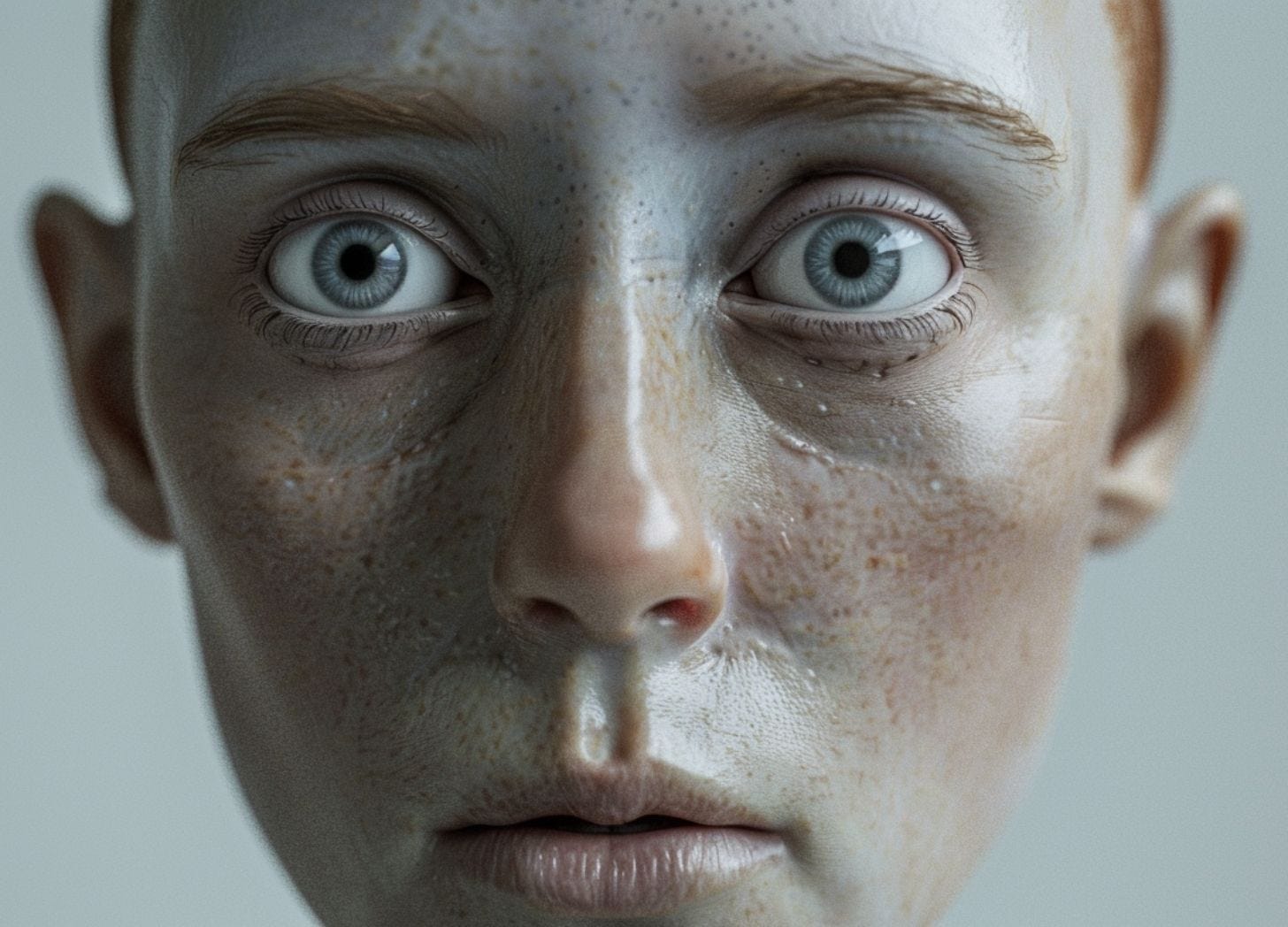
I came across one of my favorite visual illusions this morning, namely the Flashed Face Distortion Effect. It always surprises me and makes me double-check that my eyes aren’t deceiving me, but the result is always the same. Famous faces become “monster-like,” displaying features such as oversized eyes, squished noses, or elongated faces.
Have a go yourself. Hit play on the following video. Make sure your volume is on and simply follow the instructions. If you can’t get the video below to work, you can watch it on YouTube here (although please note there is no audio commentary).
What’s Going On?
As mentioned in the video commentary, what’s happening is that the previous face distorts the face that follows it. For example, a face with a deep tan may cause the next face to appear unusually pale, and a face with squinted eyes can make normal-sized eyes seem exaggeratedly large.
As with many scientific findings, the discovery of the Flashed Face Distortion Effect happened by chance. It was first reported in the journal Perception in 2011 by Jason Tangen, Sean Murphy, and Matthew Thompson from the School of Psychology at the University of Queensland.
The researchers weren’t trying to create an illusion at all. While quickly flipping through a series of eye-aligned face images for an identification study, they began noticing something strange: the faces started to look grotesque and caricatured. Yet when viewed individually, each face appeared perfectly normal. What they had stumbled upon was a powerful contrast effect.
However, contrast is only part of the story. The illusion depends just as much on where you’re looking.
It only really works in your peripheral vision. If you stare directly at the faces, they look completely normal. But at the edges of your visual field, detail drops away. Peripheral vision is excellent for detecting motion and general shapes, but it’s far less precise when it comes to fine spatial detail. That slight loss of accuracy creates room for exaggeration.
When faces are aligned at the eyes and flashed at around four or five per second, your brain is forced to keep recalibrating. It doesn’t get enough time to settle. Each new face becomes a moving reference point for the next one. Small differences in forehead height, jaw width, eye spacing, or skin tone get amplified because your visual system is working with incomplete information.
Recent research adds an important twist. The strength of the illusion depends on the exact spot in your visual field where the faces appear. When researchers suddenly switched the stream of faces from one side of the screen to another, the distortion dropped noticeably. That tells us something important. The illusion isn’t mainly about deep social interpretation or identity recognition. It seems to begin much earlier in the visual system, in the basic machinery that handles what falls on different parts of your retina.
The effect isn’t happening because your brain suddenly forgets what a normal face looks like. It’s happening because peripheral vision is less stable than we think, and rapid comparison pushes it past its limits.
Why Illusions Matter
Illusions have long fascinated psychologists and have been central to serious thinking about perception. For example, in a previous article, I wrote about the classic Old Woman/Young Woman illusion, which Professor Edwin Boring featured in the American Journal of Psychology in 1930.
What makes illusions so valuable is that they help us see how perception works.
Illusions reveal the boundaries and limits of our visual system. They show us where perception stretches, where it compresses, and where it fills in missing information. By pushing the system into unusual conditions, they allow researchers to isolate the smaller processes that normally operate so smoothly we never notice them.
Visual Illusion or Optical Illusion?
Before wrapping up, it’s worth clarifying something that often goes unmentioned. The terms optical illusion and visual illusion are usually treated as synonyms. They aren’t quite the same.
In some cases, the mismatch between perception and reality begins with how light behaves in the physical world. Light bends when it moves between different materials, reflects off surfaces, and changes direction depending on the medium it travels through. A straight pencil placed in a glass of water can look bent because the light rays are refracted as they pass from air into water. The distortion originates in physics, before the signal even reaches your brain.
In other cases, the light information itself is perfectly ordinary, but the brain’s interpretation shifts. These are visual illusions. Here, the distortion emerges from how the visual system processes incoming signals. The brain is constantly making rapid, educated guesses about what it’s seeing. Most of the time those guesses are remarkably accurate. Occasionally, under the right conditions, they overshoot.
That’s what’s happening with the Flashed Face Distortion Effect. The faces aren’t optically warped. The light hitting your retina is fine. The distortion arises from how your visual system interprets rapid, peripheral, constantly changing information.
So while all perception ultimately involves the brain, not all illusions begin in the same place. Some start with the physics of light. Others, like this one, reveal the constructive nature of vision itself.
And that’s why illusions matter. Sometimes the light bends. Sometimes the brain does. Either way, they show us that perception is not a passive recording, but an active construction.
I hope you enjoyed this brief look at the Flashed Face Distortion Effect and psychology’s enduring interest in illusions. If you found it interesting, you might want to take a look at another of my earlier articles:
About the Author

David Webb is a psychology educator and author who has spent over twenty-five years helping people make sense of why we think, feel, and behave the way we do. He runs All About Psychology, a long-running hub of articles, interviews, and resources visited by over a million people each year.
His books, including Why We Are The Way We Are, are written for curious readers interested in what makes us tick.
You can explore more of his work and books on his Amazon author page.
Keep Learning With All About Psychology
The All About Psychology Substack is your go-to source for all things psychology. Subscribe today and instantly receive my bestselling Psychology Student Guide right in your inbox.
Upgrade to a paid subscription and as an extra thank you, you’ll also get the eBook version of my book Psychology Q & A: Great Answers to Fascinating Psychology Questions.
Why Upgrade to Paid?
Every penny of paid subscriber support goes directly towards hosting and running costs, helping keep All-About-Psychology.com free for everyone.
Your support ensures that:
Students and educators can continue to access the most important and influential journal articles in the history of psychology, completely free.
Readers everywhere can hear directly from world-renowned psychologists, authors and leading experts in the field.
High-quality free content for students, educators, and the general public continues to be created and shared on a regular basis.