

Exercise Snacks
The psychology of making movement easier to start

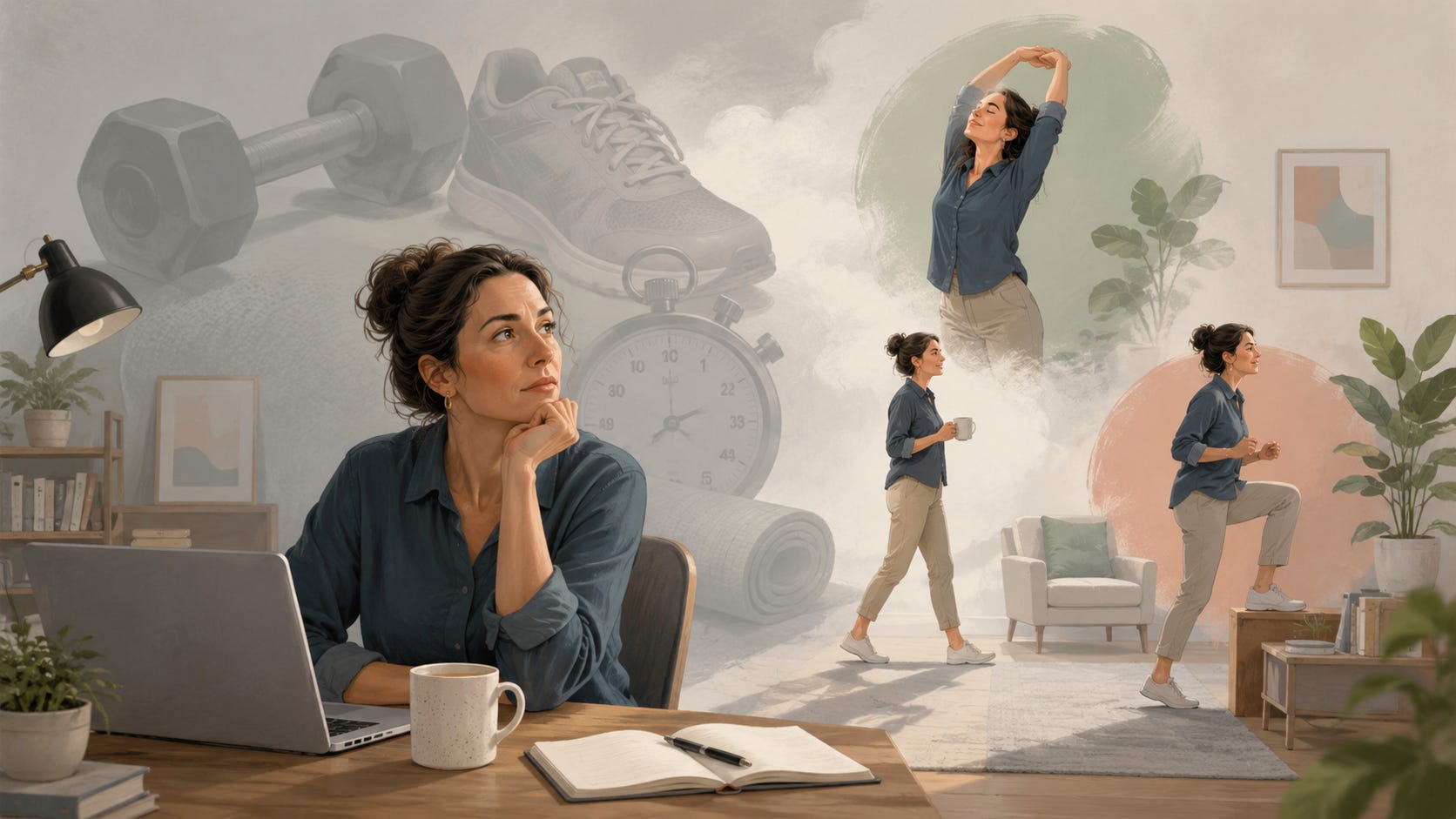
I’d like to thank my friend Darren for inspiring this article. He sent me a post on Threads he knew would pique my interest. The opening line was:
A Stanford psychologist spent 4 years proving that the simple act of walking generates 60% more creative ideas than sitting.
While tracking down the original research report to test the validity of this claim, I ended up discovering the concept of exercise snacks.
Exercise snacks are short bouts of physical activity built into the day, rather than something saved for a formal exercise session. I like the phrase because it suggests something brief and manageable. That appeals to someone like me, who finds it hard to consistently incorporate exercise into daily life because of time constraints, depleted energy, and, sometimes, lack of motivation.
Most of us know that sitting less and moving more would probably be good for us, but the problem is getting from intention to action. Exercise snacks may help because they make the first step feel less daunting.
Exercise is often thought of as something that needs a proper block of time, a consistent plan, and the right conditions. That creates obstacles before you even start. Exercise snacks may reduce some of those obstacles because they challenge the all-or-nothing thinking that can make anything less than a “proper” exercise session feel pointless.
This article looks at what exercise snacks are, what the evidence suggests they may and may not do, what the walking and creativity study actually found, and what habit psychology can tell us about making small bouts of movement easier to repeat.
What counts as an exercise snack?
Exercise snacks are not one single thing. The phrase generally refers to short bouts of physical activity spread across the day.
In their systematic review and meta-analysis of exercise snacks and cardiometabolic health, Rodríguez and colleagues defined exercise snacks as structured bouts lasting five minutes or less, performed at least twice a day, at least three times a week, for at least two weeks. The interventions they reviewed varied in duration, frequency, and intensity, from moderate-to-vigorous activity to near-maximal effort.
A broader Frontiers narrative review on exercise snacks and sedentary behavior describes exercise snacks as short, repeatable bouts of physical activity distributed across multiple points in the day. That broader definition includes the idea of breaking up prolonged sitting, not just doing brief bursts of harder exercise.
A vigorous bout of movement is not the same as a light movement break. A planned activity is not quite the same as movement that happens as part of a normal day. These may all belong to the same general idea, but they should not be treated as identical.
There is also a related concept called vigorous intermittent lifestyle physical activity, or VILPA. In research on VILPA, the term refers to brief bouts of intense physical activity embedded into daily life. It overlaps with exercise snacks, but it is usually focused more specifically on short bursts of vigorous incidental activity rather than planned exercise.
So, when we talk about exercise snacks, the first question is what kind of snack we mean. Is it vigorous or light? Planned or incidental? Designed to improve fitness, interrupt sitting, or make movement easier to fit into the day? The answer matters because the likely benefits depend on the type, intensity, and context of the movement.
What brief movement may do for fitness and metabolic health
The Rodríguez review mentioned above helps clarify where the evidence is strongest and where it’s weaker. Its clearest finding was for cardiorespiratory fitness in physically inactive adults. In plain English, that means fitness related to the heart, lungs, and circulation.
It should be stated, however, that the review focused on physically inactive adults, so it doesn’t automatically tell us what the same approach would do for people who are already active. It also doesn’t mean that every kind of brief movement has the same effect.
Research on sedentary behavior suggests short activity breaks may help with some post-meal metabolic responses. Put simply, brief movement may help reduce some of the rise in blood sugar and insulin that can happen after eating, especially when it breaks up long periods of sitting.
The evidence isn’t as clear for outcomes such as body composition, blood fats, resting blood pressure, or muscular strength. That doesn’t make exercise snacks pointless. It means we need to be specific about what the evidence does and doesn’t show.
Intensity also matters. Some of the stronger findings involve more vigorous activity, not very gentle movement. A short, hard bout of activity isn’t the same as a light break from sitting.
The health evidence is promising, but specific. Exercise snacks may help with heart and lung fitness in physically inactive adults. They may also help with some post-meal blood sugar and insulin responses.
Can walking really boost creativity?
The walking claim is worth returning to because the original paper is more specific than the Threads post suggested. The paper in question was the brilliantly titled Give Your Ideas Some Legs: The Positive Effect of Walking on Creative Thinking, by Marily Oppezzo and Daniel L. Schwartz.
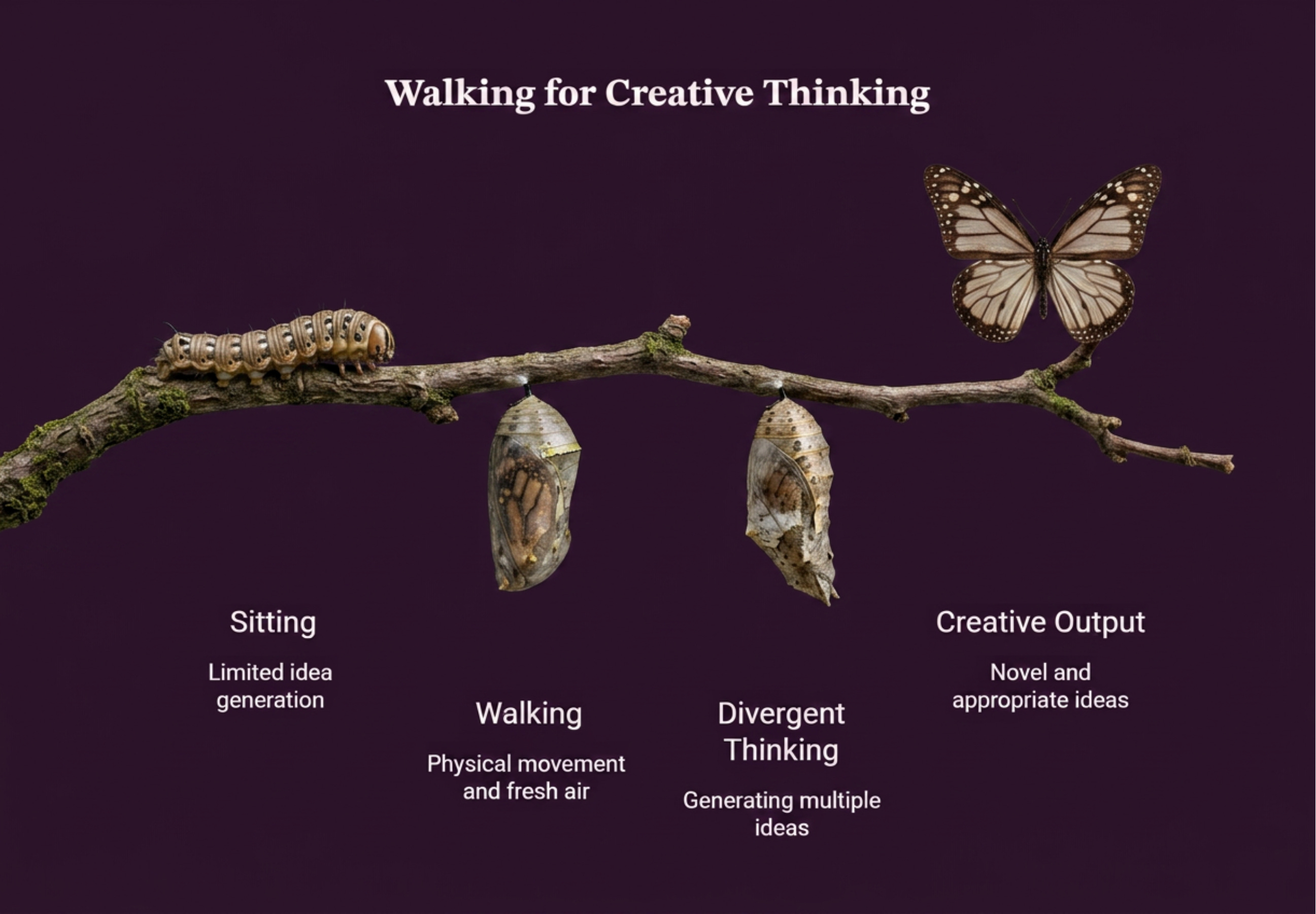
The authors treated creativity as the production of ideas that are both novel and appropriate. Their key distinction was between divergent thinking and convergent thinking. Divergent thinking means generating several possible ideas. Convergent thinking means narrowing things down to one correct answer.
The study did not show that walking improves thinking in general. It showed a much stronger effect on divergent thinking. In Experiment 1, participants completed a task where they had to think of unusual uses for everyday objects.
Participants produced more novel and appropriate responses while walking than while sitting. The authors reported that 81% of participants improved their creative output while walking, and that the average increase in creative output was around 60%.
Across the same paper, participants also did better on divergent-thinking tasks after walking, even when they had sat down again. A similar pattern appeared when people walked outdoors.
The result was different for convergent-thinking. Here participants had to find a single correct word linking three other words. Walking did not help on that task. In fact, participants did mildly worse on it while walking.
So the 60% claim has some support, but only if it is worded accurately. Walking appeared to help people generate more novel and appropriate ideas on specific creativity tasks. It does not mean walking improves every kind of thinking, problem solving, or decision-making.
The safest takeaway is modest. A short walk may be useful when the task is to generate ideas, possibilities, or rough first thoughts. It should not be treated as a reliable way to solve every kind of mental task.
Why small movement habits may be easier to start
Habit psychology is useful here because it shifts attention away from motivation alone. In Wood and Neal’s work on health habits, the point is not that people simply need better intentions. Repeated behavior is more likely when the situation itself helps prompt the action.
Small bouts of activity may have an advantage in this respect. A behavior that takes less time and planning may be easier to connect to a stable cue. The cue could be something that already happens in the day, so the behavior doesn’t depend entirely on remembering, deciding, and talking yourself into it each time.
In that sense, exercise snacks overlap with the wider idea of micro-habits. These are small behaviors that may be easier to repeat because they ask less of us at the point of action.
The short-term intervention evidence is encouraging. Adherence and compliance were high across the exercise-snack studies reviewed, but the interventions were short. This suggests people can often follow these routines for a limited period. It doesn’t prove that they become lasting habits.
In Lally and colleagues’ study of habit formation in everyday life, the time it took for a behavior to become more automatic varied widely. The often-quoted average was around 66 days, but the range was much wider, from 18 to 254 days. So it would be misleading to treat 66 days as a fixed rule.
Real life can still get in the way. A qualitative study on interrupting sitting while working from home found that desk-based workers can face barriers such as workload, uncertainty about when it is acceptable to take a break, and feeling guilty for stepping away from work. The problem isn’t always lack of knowledge. Sometimes the work setting makes movement feel harder to justify.
How to use exercise snacks without overthinking them
The best way to use exercise snacks is not to turn them into another rule to follow. The aim is to make movement easier to notice and easier to do.
Start with the reason for moving. If you are trying to generate ideas, a short walk may be useful. If you have been sitting for a long time, a brief movement break may be enough to interrupt that stretch of inactivity. If you want something more fitness-focused, the evidence suggests intensity matters, so gentle movement and harder movement should not be treated as the same thing.
It also helps to connect movement to something that already happens in the day. That does not mean turning every routine into a rule or a target. It means looking for ordinary moments where a short bout of activity would fit without needing a lot of planning.
The expectations need to stay realistic. Exercise snacks are not a replacement for regular exercise. They are not a guaranteed way to improve every health measure, solve difficult problems, or create a lasting habit. They are, however, practical, actionable, and easy to try.
Final thoughts
What began with my friend sending me a claim about walking and creative thinking ended up introducing me to the idea of exercise snacks, but it also made me wonder what else could be made “snack size.”
Could other positive behaviors work better if we made them smaller, easier to start, and easier to repeat? Not as a replacement for doing more, but as a way to get started.
This seems relevant when we think about everyday psychological wellbeing. Some helpful behaviors are valued in principle but still hard to do regularly. Mindfulness is a good example. A full meditation session may feel like something that needs time, quiet, and the right mood. A smaller version might mean taking a few seconds to notice your breath and slow it down for a moment.
What other psychologically beneficial behaviors do you think could be made “snack size,” and what might that look like in practice?

Keep learning with All About Psychology
The All About Psychology Substack is your go-to source for all things psychology. Subscribe today and instantly receive my bestselling Psychology Student Guide right in your inbox.
Upgrade to a paid subscription and as an extra thank you, you’ll also get the eBook version of my book Psychology Q & A: Great Answers to Fascinating Psychology Questions.
Why Upgrade to Paid?
Every penny of paid subscriber support goes directly towards hosting and running costs, helping keep All-About-Psychology.com free for everyone.
Your support ensures that:
Students and educators can continue to access the most important and influential journal articles in the history of psychology, completely free.
Readers everywhere can hear directly from world-renowned psychologists, authors and leading experts in the field.
High-quality free content for students, educators, and the general public continues to be created and shared on a regular basis.
About Me

I’m David Webb, a psychology educator and author who has spent over twenty-five years helping people make sense of why we think, feel, and behave the way we do.
I founded the All About Psychology website in 2008 and have been building it ever since as a place where students, educators, and curious readers can explore the many branches of psychology, learn about the field’s history and most influential pioneers, and access thousands of full-text journal articles and other quality psychology materials. Today the site is home to one of the largest and most engaged independent psychology communities online. This Substack is the latest addition to the All About Psychology platform.
My books, including Why We Are The Way We Are, are written for anyone interested in what makes us tick.
You can explore more of my work and books on my Amazon author page.
Great read, as always - thanks. I was especially interested in the element that addressed the relationship between walking and creative thinking. I'm delighted that you brought clarity and realism to the study's claims. For me, there are two fundamental flaws in the study.
First, for far too long, creativity scholars have extrapolated from divergent thinking tests to draw conclusions about creativity and creative thinking. Divergent thinking is one tiny part of creativity, and an only slightly larger part of creative thinking. And the tests themselves are of dubious merit. I believe it was Mark Runco who said we might be better off without them.
Second, the study authors have used what is effectively Stein's standard definition of creativity (https://doi.org/10.1080/10400419.2012.650092), which includes the two qualifications, novel and useful. This definition has been widely accepted within the field. Yet, the two qualifications have no place in the authentic definition of creativity, which is simply the act of bringing something into existence. They seem to have appeared quietly in the 19th century when scholars were exploring the nature of genius, and have made themselves comfortable ever since. Worse, they have been used to exclude outputs that would otherwise be considered creative (https://doi.org/10.1002/jocb.137).
I believe the world would be a better place if we ditched divergent thinking tests and democratised creativity.
Quite a lot of food for thought - I would go out and take a walk right now if it wasn't so late at night :) Jokes apart, an excellent read!