

Brain Rot
From Plato to TikTok: the anxiety about technology rotting our minds is older than you think, and the science is considerably more nuanced than the headlines suggest.

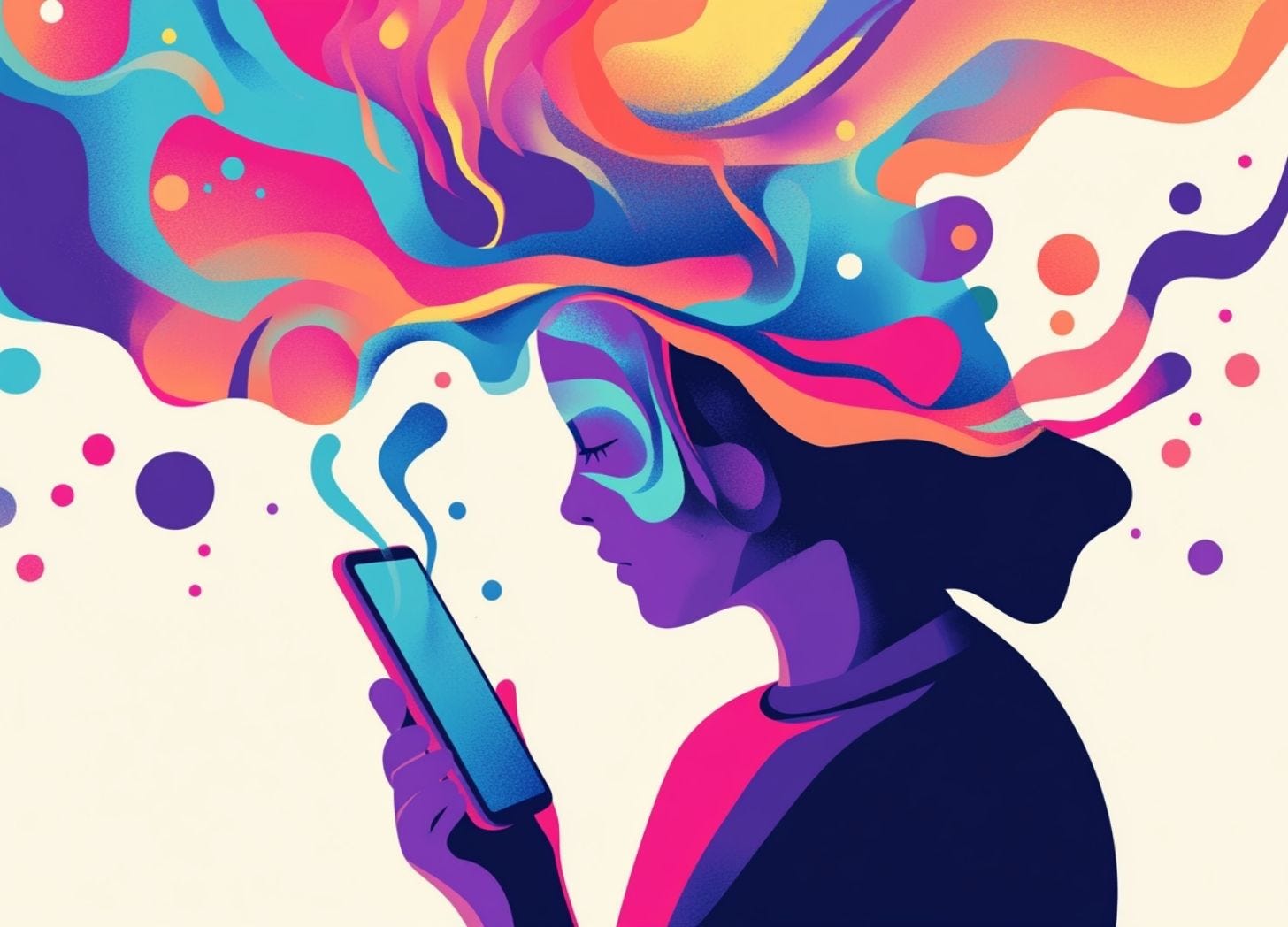
I recently came across an episode of The Diary of a CEO featuring social psychologist Jonathan Haidt and Harvard physician Dr. Aditi Nerurkar, making the case that platforms like TikTok are rewiring our brains. It was compelling and alarming in equal measure. Here’s a short clip titled:
BRAINROT IS DESTROYING YOUR BRAIN!
As always with a topic that catches my eye, I explored the psychological literature to see what I could find. As a result, in this article, I’ll look at where the term brain rot actually comes from (the answer might surprise you, it certainly did me!), what the research genuinely shows about attention, memory, and short-form video, and why certain writers on the subject think the whole brain rot panic is overblown.
First things first: what do we actually mean by brain rot?
Oxford University Press named brain rot its Word of the Year for 2024, reflecting its explosion in use across social media, particularly among Generation Z and Generation Alpha. In its current form, the term refers to a perceived deterioration in mental and intellectual functioning, supposedly caused by the overconsumption of low-quality, highly stimulating digital content.
The term itself is over 170 years old. Henry David Thoreau used it in Walden in 1854 to criticize society’s preference for intellectual simplicity over the harder work of genuine thought.
While England endeavors to cure the potato-rot, will not any endeavor to cure the brain-rot, which prevails so much more widely and fatally?
Psychologically speaking, brain rot has no formal clinical status. It doesn’t appear in any official psychiatric diagnostic manual. But it has attracted serious scientific attention. A recently validated psychometric tool called the Brain Rot Scale (BRS-14), developed and tested with digital natives aged 8 to 24, identifies three core dimensions: attention dysregulation, the difficulty sustaining focus on offline or complex tasks; digital compulsivity, the habitual and often involuntary urge to scroll or check devices; and cognitive dependency, a growing reliance on external digital tools for basic mental functions.
It’s worth noting that brain rot, as measured by the BRS-14, is distinct from ADHD and distinct from depression, though the symptom profiles can overlap in ways that make the distinction clinically important.
What the research actually shows - and what it doesn’t
One of the few researchers who has spent decades tracking how people actually behave with digital devices in real-world settings rather than labs is Dr. Gloria Mark, a professor of informatics at the University of California, Irvine. Her longitudinal work, covered extensively by the American Psychological Association, documents a striking decline in how long people sustain focus on a single digital task. In 2004, the average was around 150 seconds. By 2024, it had dropped to 47 seconds.
That number refers specifically to sustained attention on a single digital task, not to attention span in the broader cognitive sense. The two are related but not the same thing. And the research describes a correlation over time rather than a clean causal story about what drove the decline.
Research on short-form video points in a consistent direction. A narrative review published in 2025, covering studies from 2019 onward, found associations between high-frequency short-form video use and reduced inhibitory control, disrupted working memory, and lower academic performance. A 2026 systematic review in the International Journal of Adolescence and Youth found similar patterns specifically in younger users. The proposed mechanism is that platforms like TikTok and Instagram Reels exploit the brain’s dopamine reward system, offering unpredictable bursts of novelty that condition users to keep scrolling. Because the rewards are intermittent, the behavior becomes particularly resistant to change.
Perhaps the most striking recent finding involves writing and AI. Researchers at MIT, reporting in Psychology Today, used EEG to monitor students’ brain activity during an essay-writing task. One group wrote using only their own thinking. A second used a search engine. A third used an AI chatbot. The group writing without assistance showed the strongest neural engagement. The chatbot group showed the weakest, by a considerable margin. The researchers described it as the brain essentially not getting a workout.
Importantly, the concern isn't just passive scrolling. It's the possibility that outsourcing our thinking to AI tools carries its own cognitive cost, one we're only beginning to understand.
The other side of the argument
Andrew Przybylski is a professor of human behavior and technology at Oxford University who has been one of the more prominent voices urging caution in this debate. In a 2023 study published in the journal Cortex, he and his colleagues tracked nearly 12,000 children and found no significant negative impact of screen time on functional brain connectivity or self-reported well-being. Young people with access to high-speed internet actually reported higher levels of happiness across a range of metrics.
His broader argument is that much of the brain rot panic is driven by studies with small samples, correlational designs, and no control groups. He points out that every new medium has triggered this kind of alarm. The novel in the 19th century. Radio. Television. Video games. Actually, this type of anxiety goes back much further than that. In his dialogue Phaedrus (c. 370 BCE), Plato records Socrates arguing that writing will produce forgetfulness in the souls of those who learn it. Rather than remembering from within, people will trust external characters, gaining only the appearance of wisdom rather than its reality, becoming, in Socrates' words, hearers of many things who actually know nothing. The irony is hard to miss: an argument against writing, preserved entirely because Plato wrote down Socrates's views on the subject.
There's also an argument that outsourcing certain cognitive tasks to technology doesn't rot the brain so much as redirect it, freeing up resources for more complex work. Research on cognitive offloading, the practice of using external tools to reduce the mental effort required for a task, does suggest this can happen in some circumstances, though whether it represents a net cognitive gain or loss remains genuinely contested.
Why teenagers are choosing brain rot deliberately
A qualitative study published in 2025 by Emilie Owens of the University of Oslo, in the journal New Media and Society, reframes much of the alarm surrounding brain rot in an interesting way. Rather than treating it as something that happens to young people, Owens argues it is something they actively choose.
Drawing on data from seven TikTok workshops conducted with 16 and 17-year-olds in Oslo, the study found that teenagers don’t experience brain rot consumption as passive or accidental. They described it as a specific strategy, and they were remarkably clear about what it was for.
When asked to define brain rot, the participants settled on three defining features: it is childish or unserious; it provides no cognitive or developmental benefit; and it is deliberately non-productive. That last point was stated with some emphasis by one participant: “It’s not productive. That’s the point.”
Owens locates her findings within what she calls a decompression-driven genre of participation, whereby young people actively resist the cultural pressure towards constant self-improvement and productivity. The teenagers in the study were attending a fee-paying international school and were keenly aware of the expectations placed on them. Brain rot, in this context, functions less as a failure of self-regulation and more as a conscious rejection of it.
What also emerged from the workshops was a more nuanced picture of how teenagers actually use TikTok. One participant described brain rot not as a type of content but as a mode of communication, noting that TikTok “speaks to me in brain rot” in a way that made even complex subjects like mathematics easier to understand than a conventional school lesson. For these teenagers, brain rot was less a cognitive state and more a shared language they knew how to read.
Owens is careful not to present an unqualified endorsement of the practice. Several participants in the study described losing hours to TikTok against their intentions, and the research acknowledges links between excessive mindless scrolling and feelings of anxiety. The endless scroll afforded by apps like TikTok adds a dimension that historical forms of leisure, such as binge-watching television or going on holiday, did not have: there is no natural endpoint.
The balanced picture that emerges from this research is not that brain rot is harmless, but that it’s not simply the passive cognitive collapse it’s often portrayed as. For many young people it is, at least in part, a considered response to the pressures of modern life. Whether the physiological effects of the content align with that intent is, as the wider research suggests, a separate question.
Awareness is key
Regardless of where you sit on the brain rot debate, it's clear that unintentionally losing hours to platforms like TikTok and anxiety induced through endless scrolling are real issues: here's what the research suggests can help.
A 2023 systematic review published in the Journal of Medical Internet Research looked at the effectiveness of different approaches to managing problematic social media use. Simple abstinence, the classic digital detox, showed improvement in only 25% of studies. Limiting daily screen time fared similarly, at around 20%. Some studies found that full abstinence actually increased feelings of loneliness by severing social connections people genuinely valued.
By contrast, therapy-based interventions, particularly those drawing on Cognitive Behavioral Therapy, showed improvement in 83% of studies. The key difference wasn’t willpower or restriction. It was reflection: helping people understand why they use social media, what they’re actually seeking from it, and how to build intentional habits around it rather than fighting what often turns into an unwinnable war of self-denial.
That distinction maps well onto what the teenagers in Owens's study were already doing intuitively. They weren’t trying to quit. They were trying to use the technology on their own terms.
A few other evidence-based suggestions from the literature are worth mentioning. Research highlights that physical activity, specifically high-intensity training for at least 20 minutes three or more times per week, or moderate-intensity activity on five or more days, has been associated with building cognitive reserve against the neurological impacts linked to heavy digital use. And several studies point to mindful friction, the practice of deliberately introducing small barriers to compulsive scrolling as more effective than abstinence: disabling notifications, deleting the most distracting apps, and taking a few quiet minutes before reaching for the phone in the morning.
Final thoughts
Most of the brain rot research is correlational, not causal. We can’t say with certainty whether heavy short-form video use causes attention difficulties, or whether people who already struggle with attention are simply more drawn to highly stimulating content. The longitudinal studies needed to answer that question properly don’t yet exist at scale.
What we can say is that the brain is remarkably plastic. It responds to its environment. And the environment most of us now inhabit is unlike anything our brains evolved to navigate. Whether that constitutes a genuine emergency or a slow adaptation in progress remains to be seen.
One of the more personally interesting discoveries from exploring this topic was that when looking for supposed examples of brain rot content, one reference kept cropping up: Skibidi Toilet, a fast paced dystopian series of YouTube videos and shorts by Alexey Gerasimov featuring animated toilets with human heads attempting world domination, fought off by humanoids with CCTV cameras for heads, all set to a remixed song built around the word skibidi, what's not to like.
This is the first clip I came across. Whether it constitutes brain rot, I'll leave for you to decide. My initial reaction was, wait, is that Kate Bush 😂 followed by wow, when I saw that the Skibidi YouTube channel has over 47 million subscribers!
I'll leave you with the idea that genuine absorption in something is preferable to passive consumption. That might be a Netflix series, a book, a long walk, a conversation, or even, yes, absurdist online content watched all the way through.
About the author

David Webb is a psychology educator and author who has spent over twenty-five years helping people make sense of why we think, feel, and behave the way we do. He runs All About Psychology, a long-running hub of articles, interviews, and resources visited by over a million people each year.
His books, including Why We Are The Way We Are, are written for curious readers interested in what makes us tick.
You can explore more of his work and books on his Amazon author page.
Keep learning with All About Psychology
The All About Psychology Substack is your go-to source for all things psychology. Subscribe today and instantly receive my bestselling Psychology Student Guide right in your inbox.
Upgrade to a paid subscription and as an extra thank you, you’ll also get the eBook version of my book Psychology Q & A: Great Answers to Fascinating Psychology Questions.
Why Upgrade to Paid?
Every penny of paid subscriber support goes directly towards hosting and running costs, helping keep All-About-Psychology.com free for everyone.
Your support ensures that:
Students and educators can continue to access the most important and influential journal articles in the history of psychology, completely free.
Readers everywhere can hear directly from world-renowned psychologists, authors and leading experts in the field.
High-quality free content for students, educators, and the general public continues to be created and shared on a regular basis.
This article came through at the point when I am 2 weeks into full abstinence from social media so this is a very interesting read for me, thank you. Not completely motivational for my abstinence journey though 😅
Such a crucial topic. That’s partly the reason why I moved here. Long and short form written content is far better for your brain than short form video content like reels on Instagram. Reading and writing actually helps develop the higher order regions of the brain!