

Anthropomorphism
Why humans keep seeing intention, meaning, and emotion in nonhuman things

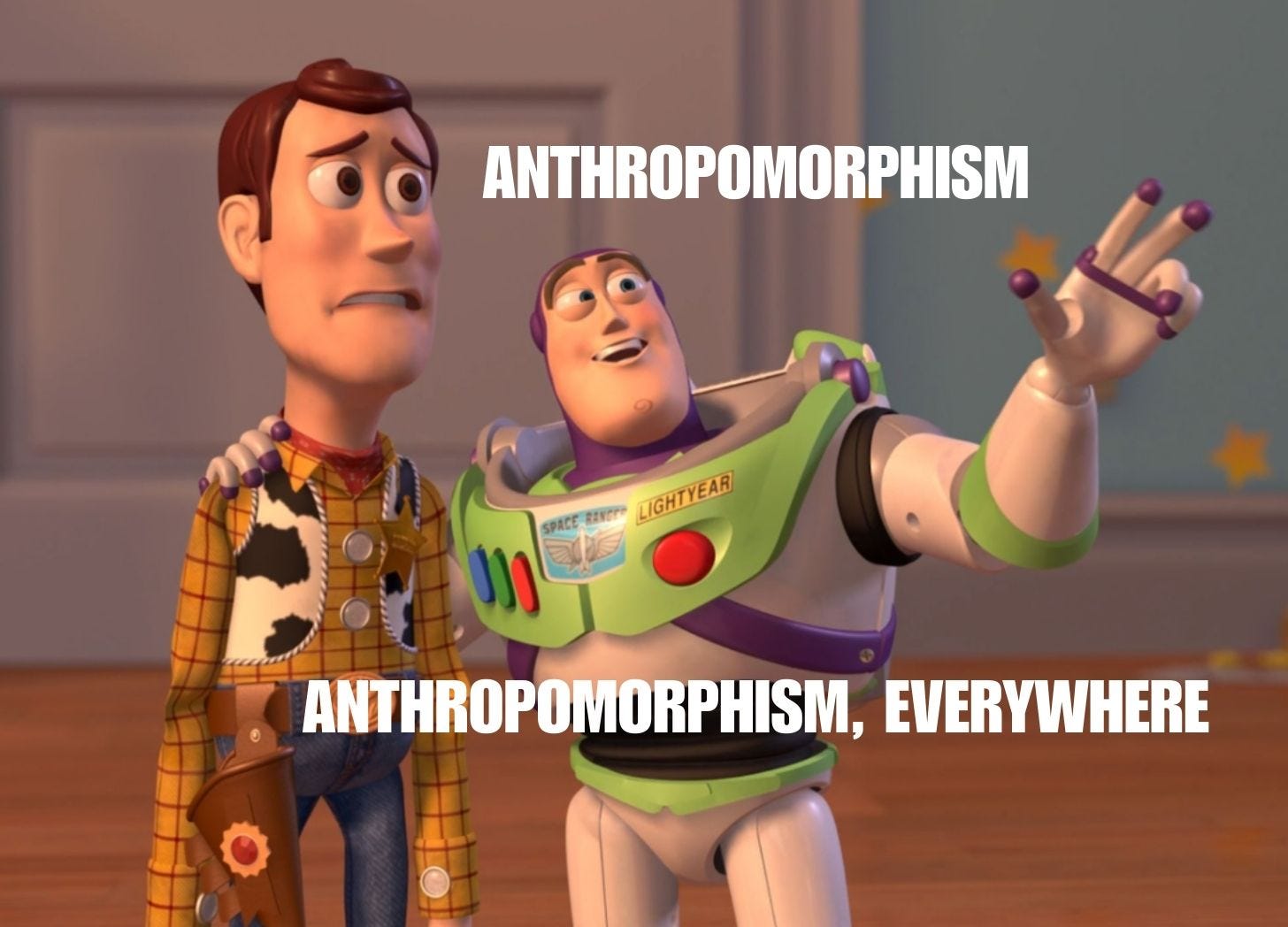
I originally planned to include a section on anthropomorphism in my recent piece on the “nihilist penguin,” given how many people draw on human intentionality when trying to understand the penguin’s behavior. However, it’s such an interesting topic that I decided it deserved an article of its own. Plus, it means I get to include a video of dogs looking “guilty.”
What Anthropomorphism Actually Is
The American Psychological Association defines anthropomorphism as:
“the attribution of human characteristics to nonhuman entities such as deities, spirits, animals, plants, or inanimate objects. It is a fundamental tendency of the human imagination as reflected in language, religion, and art.”
The only addition I would make to this definition is memes, alongside language, religion, and art, given how often anthropomorphism shows up in the way animals and other nonhuman things are framed, captioned, and shared online (see section below).
Even with a clear definition, anthropomorphism is often treated as something simpler than it really is.
When someone says a storm is angry, a laptop doesn’t want to cooperate, or a pet knows it’s done something wrong, this is often dismissed as figurative speech rather than a functional psychological process.
Anthropomorphism isn’t just about using human language to describe nonhuman things. It involves attributing human mental states, such as intentions, beliefs, or feelings, to something that is not human.
Saying an animal behaves in a certain way is not the same as saying it wants something, understands something, or is choosing something. Anthropomorphism arises when we move from describing behavior to inferring an inner life that resembles our own. Such as claiming that dogs look or feel guilty.
What may look or feel like guilt, is far more likely to be an appeasement response to a human’s tone, posture, or emotional state than awareness by the dog of having done something wrong. Pets learn patterns of behavior through consequences and reinforcement, not by reflecting on right and wrong. By the time an owner discovers the damage, the animal is unlikely to remember the action itself. The lowered head, averted eyes, or hunched posture that gets read as remorse is better understood as an attempt to defuse tension and avoid conflict, not an expression of guilt in the human sense.
In other words, the human interpretation supplies the inner experience. The animal’s behavior provides the raw material, but the mental state is projected onto it afterwards.
It’s also worth being clear about what anthropomorphism is not. It isn’t childish, naïve, or a simple error people make when they don’t know better. Adults do it just as readily as children, often in more subtle ways. Nor is it something that disappears with education or scientific knowledge.
Why Humans Anthropomorphize In The First Place
At its core, anthropomorphism reflects how humans make sense of the world.
We are social creatures and quickly learn to understand what’s happening around us by interpreting intentions, motives, and feelings. Other people are our primary reference point for explaining why things happen, so when something is unclear or unpredictable, the mind often reaches for that same framework.
This tendency becomes especially noticeable in situations that are ambiguous, complex, or hard to control. When outcomes feel random, when systems behave in ways we don’t fully understand, or when events resist straightforward explanation, purely mechanical accounts can feel unsatisfying. They describe what happened, but not why in a way that feels meaningful.
Anthropomorphism steps in at that point. Attributing intention or agency gives shape to uncertainty. It turns something vague into something interpretable. A system that is “deciding,” a device that is “misbehaving,” or an animal that is “choosing” suddenly feels easier to think about than one that is simply behaving according to impersonal forces.
Anthropomorphism isn’t a failure of rational thought. It’s a cognitive shortcut. When faced with complexity or unpredictability, the mind defaults to the explanatory tool it knows best: human mental life.
The Psychological Conditions That Make Anthropomorphism More Likely
Research has tried to pin down why anthropomorphism shows up more strongly in some situations than others. One of the most widely cited accounts comes from Nicholas Epley and colleagues, who argue that anthropomorphism becomes more likely in relation to a specific set of psychological triggers.
Rather than thinking of these as separate causes, it’s more useful to see them as overlapping conditions that tend to cluster together.
One of those conditions is limited understanding. When understanding breaks down, human mental models tend to take over. This is why people describe computers as stubborn, cars as temperamental, or algorithms as unpredictable in almost personal ways. Human minds are the richest explanatory models we have, so when technical understanding runs thin, those models get reused.
Another condition involves the desire for predictability and control. Shouting at a laptop that freezes or blaming a device for “not cooperating” doesn’t fix the problem, but it transforms a frustrating experience into something that feels more structured. Intention, even imagined intention, is easier to engage with than randomness.
A third condition has to do with social connection. When people feel isolated, unsupported, or simply alone with a task, anthropomorphism becomes more pronounced. Pets are talked to as if they understand not just commands but moods. Objects are named. Technologies are addressed directly. In these moments, anthropomorphism fills a social gap as well as a cognitive one.
Anthropomorphism isn’t something that appears randomly. It follows a recognizable psychological pattern, shaped by how much we understand, how much control we feel, and how socially connected we are at the time.
Why We’re So Quick To See Intention Everywhere
As alluded to above, a major reason for anthropomorphism is that the human mind is biased toward detecting agency.
When something moves unexpectedly, behaves irregularly, or produces an outcome we didn’t anticipate, the first question we tend to ask is not what happened, but who did this or why did it do that.
From a psychological and evolutionary perspective, this makes sense. Interpreting a rustling noise as caused by something with intentions, even when it turns out to be nothing, is a safer strategy than ignoring it altogether. As a result, people are generally more tolerant of false positives for agency than false negatives.
Once agency is assumed, even loosely, it becomes easy to extend it into motives, moods, or decisions. The “nihilist penguin” sits squarely in this space. A lone animal moving away from the group invites questions of purpose almost immediately. The behavior is visible. The cause is unclear. Agency rushes in to complete the picture.
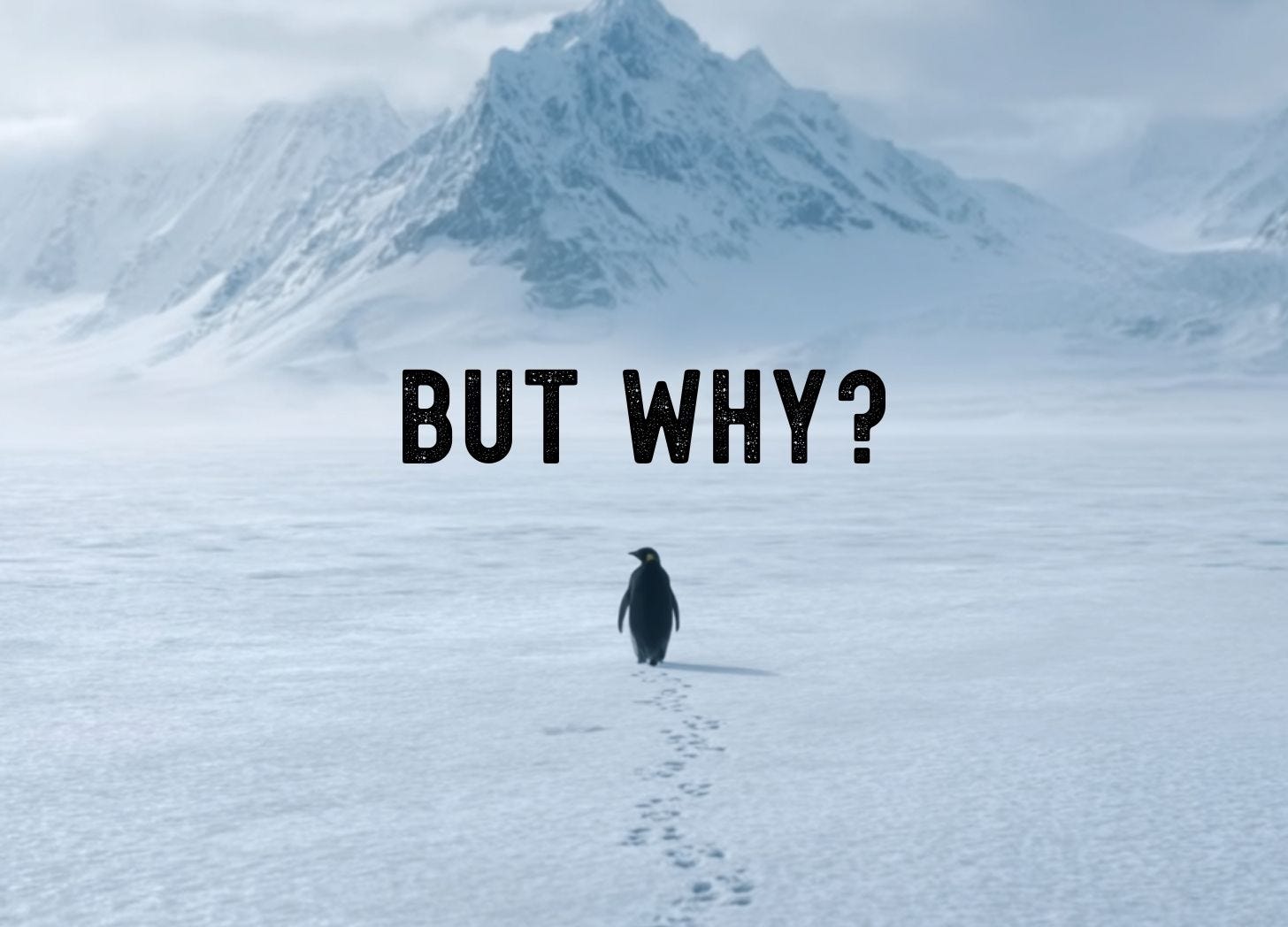
Anthropomorphism often kicks in not because the evidence demands it, but because the absence of intention feels harder to sit with than the possibility of one.
Memes, Media, And The Shortcut To Meaning
Anthropomorphism becomes especially powerful in meme culture because memes are designed to move fast.
A meme doesn’t have space for explanation. It has to land immediately. Anthropomorphism helps by doing a lot of work at once. It turns a moment, an image, or a behavior into something that already feels meaningful, without needing to spell anything out.
When an animal is framed as tired, done, defiant, or quietly resolute, viewers don’t need background context. The inner life has already been supplied. What might otherwise be a neutral or ambiguous scene becomes a story with emotional shape. Something has happened. Someone feels a certain way about it.
This is why anthropomorphism works so well as a shortcut to meaning. It bypasses analysis and goes straight to recognition. The viewer doesn’t have to ask what’s going on. They’re invited to feel it.
Animal memes, in particular, function as emotional placeholders. The animal stands in for a state of mind that might feel awkward, heavy, or overly revealing to express directly. In the case of the “nihilist penguin,” exhaustion, disengagement, quiet resistance, or low-level despair are projected onto a nonhuman figure and shared at a safe distance.
At the same time, many of these memes are simply meant to be funny and work precisely because of our tendency to attribute human characteristics, emotions, and motivations to nonhuman things.
A Tendency Worth Paying Attention To
Psychological tendencies like anthropomorphism are always worth exploring because they reveal something basic about how the mind works. They point to general inclinations toward particular ways of thinking, patterns that show up again and again across different situations and stages of life.
These tendencies are not quirks or errors so much as deeply ingrained habits of thought. They function as mental shortcuts, allowing people to make sense of the world quickly, especially when information is incomplete, ambiguous, or emotionally charged.
That’s why anthropomorphism shows up everywhere. It runs through literature, film, television, religion, advertising, and now memes. Its persistence across time and culture is a reminder that this is not a passing habit or a modern distraction, but a stable and enduring feature of human psychology.
If you start looking for it, you’ll see it everywhere. For me, one of the most powerful examples of anthropomorphism will always be the 1982 animated classic The Snowman, based on Raymond Briggs’s iconic book.
I’d be curious to know what examples stick with you. Feel free to share your favorite or most memorable anthropomorphic character in the comments.
My New Book

My new book, Why We Are the Way We Are: Psychology for the Curious, brings together the most popular and meaningful pieces from my psychology writing in one place. My hope is that you’ll find it engaging, accessible, and thought-provoking.
Paperback: https://www.amazon.com/dp/B0G4D1WJCW
Kindle eBook: https://www.amazon.com/dp/B0G4BGR9T3
Any profit from sales goes straight into supporting the All About Psychology website and social channels, which have provided free, high-quality resources for students, educators, and anyone curious about psychology since 2008.
All the very best,
David Webb
About the Author

David Webb is a psychology educator and author who has spent over twenty-five years helping people make sense of why we think, feel, and behave the way we do. He runs All About Psychology, a long-running hub of articles, interviews, and resources visited by over a million people each year.
His books, including Why We Are The Way We Are, are written for curious readers interested in what makes us tick.
You can explore more of his work and books on his Amazon author page.
Keep Learning With All About Psychology
The All About Psychology Substack is your go-to source for all things psychology. Subscribe today and instantly receive my bestselling Psychology Student Guide right in your inbox.
Upgrade to a paid subscription and as an extra thank you, you’ll also get the eBook version of my book Psychology Q & A: Great Answers to Fascinating Psychology Questions.
Why Upgrade to Paid?
Every penny of paid subscriber support goes directly towards hosting and running costs, helping keep All-About-Psychology.com free for everyone.
Your support ensures that:
Students and educators can continue to access the most important and influential journal articles in the history of psychology, completely free.
Readers everywhere can hear directly from world-renowned psychologists, authors and leading experts in the field.
High-quality free content for students, educators, and the general public continues to be created and shared on a regular basis.
Most memorable anthropomorphic character you ask? One word popped into my mind! Claude. As well as any of the generative AI chatbots. I think they are built on purpose to mimic human behavior as a way to make them more relatable and engaging for end users. It is like pure magic, you ask a question in natural language and it will answer in the same language, tone and degree of sophistication as the question posed. However unlike everyday people who are just trying to make sense of the world around them, the creators and operators of such platforms have different motives mainly driven by profit and market dominance initiatives. At the same time the chatbots had to generate responses that would make sense to anyone using them so in a way it is a necessary evil.
Why do people have the tendency to anthropomorphize in general? Perhaps we are indeed projecting our own feelings onto our environment and the environment reacts like the dog displaying signs of 'guilt'. Because that is how we make sense of the world, probably that is why people of ancient times sacrificed animals or made offerings to the Gods in order to appease them, so they can enjoy a milder winter where their crops or livestock would prosper.
Hi David. I agree with you that anthropomorphism has become much too common and casual in its usage in the general population. However, there is also the opposite problem of people, especially those in the scientific community, taking the lack of intent, problem solving, emotion etc, in animals as axiomatic. All you have to do is read any of Frans de Waal’s research and/or books, to know that that too is an over simplification.